During laparoscopic surgery, the use of instruments such as ultrasonic scalpels, electrosurgical scalpels, and argon gas scalpels will produce a lot of smoke. In addition, the incision of minimally invasive surgery is small, and the surgical operation space is relatively closed. Excessive smoke emission will block the doctor's field of vision and affect the surgical operation. During laparoscopic surgery, the establishment of an artificial insufflator is a very critical step, which plays a role in providing surgical operation space, improving the doctor's field of vision, and reducing patient damage.
Disadvantages of traditional solutions: During the operation, the doctor needs to discharge smoke through the valve of the puncture device many times, resulting in prolonged operation time. Not only that, harmful chemicals produced by tissue carbonization and protein decomposition, as well as active viruses, active cells, and blood-borne pathogens will be released into the operating room environment, posing a certain health threat to medical staff.
Traditional insufflator solution: The design is relatively simple, focusing on how to quickly and safely establish and maintain pneumoperitoneum. Most of them can only achieve basic inflation and pressure maintenance functions in laparoscopic surgery, and cannot solve the problem of smoke emission.
Innovative solution: The microcure-medical team has launched a new constant pressure, smoke filtering minimally invasive surgical intelligent Insufflator system, which can shorten the operation time by 1/4. It can intelligently manage surgical smoke, realize hierarchical filtration and closed circulation smoke exhaust design, greatly improving the safety of surgery and visual clarity. In addition, the system can maintain stable abdominal pressure under low flow and low pressure, improving surgical efficiency.
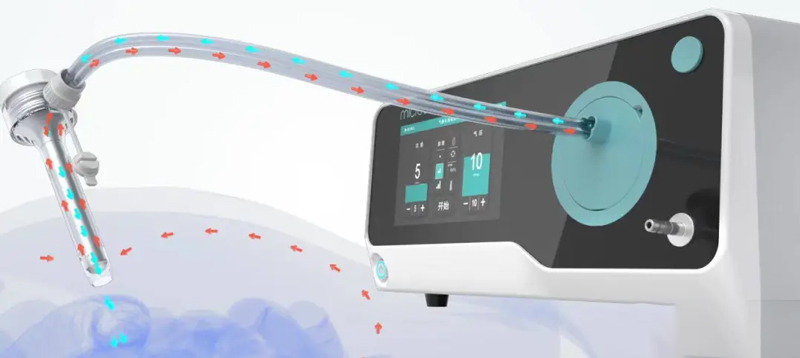
The microcure-medical intelligent Insufflator system uses an intelligent UI operation interface on the host, which divides the operation into circulating smoke filtering mode and standard mode, and can select the appropriate operation mode according to different surgical needs. In standard mode, the system can be used with conventional puncture devices to achieve high-flow ventilation and stable pneumoperitoneum to meet clinical use needs. In circulating smoke filtering mode, the filter tube group will be equipped with a smoke exhaust puncture device with a double-layer valve design to provide airflow circulation, achieve continuous smoke removal and stabilize abdominal pressure.
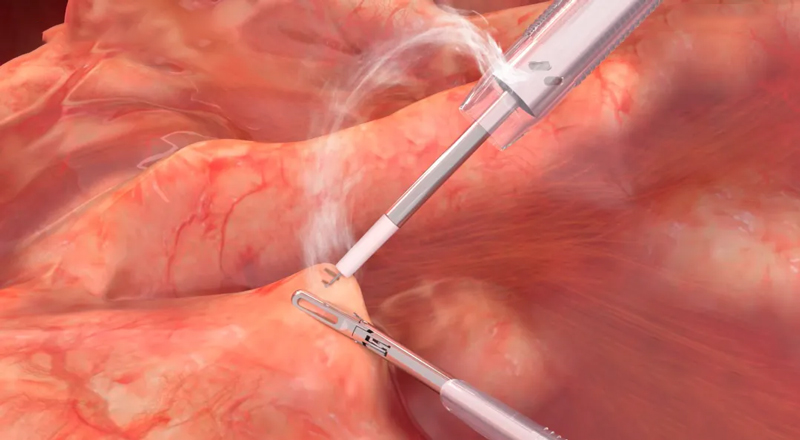
Achieve a closed cycle to ensure that there is no smoke or toxic gas leakage during the operation, thereby ensuring the cleanliness of the surgical environment and reducing the health threat to medical staff; secondly, the system can achieve instant smoke removal, and can exhaust smoke in real time during the entire surgical operation to ensure a clear surgical field of view, without the need for doctors to perform additional smoke exhaust operations, thereby improving the smoothness of the operation and shortening the operation time.
Clinical trial data show that compared with the use of conventional Insufflator, the intelligent Insufflator system can shorten the average operation time by 1/4, and performs particularly well in operations such as uterine fibroids, cervical cancer, and gastric cancer. The system is suitable for a variety of surgical scenarios, such as transanal approach surgery, operations with a strong demand for constant pressure smoke removal, and operations with small operating spaces. In operations such as gynecology, hepatobiliary surgery, anorectal surgery, and gastrointestinal surgery, it can provide a stable pneumoperitoneum environment and a clear surgical field of view, helping doctors to better complete surgical operations.
In addition, the system has a high-efficiency filtration function, which can make the filtration rate of tiny particles as high as 99.99%, and can effectively block and filter toxic particles and even bacteria and viruses.
The sales revenue has increased by more than 200% for 6 consecutive years, covering more than 90 countries in Asia, Europe, Australia, Africa and South America, and cooperating with more than 400 agents. The company has 12 EU CE certificates and successfully passed the TUV certification of South Germany. It has also cooperated with many tertiary hospitals such as Peking University First Hospital, Beijing Friendship Hospital, and Guangzhou Zhongshan Hospital. At the same time, the system has penetrated into overseas markets, achieved hospitalization in countries such as the United Arab Emirates and Brazil, and has been highly recognized by local doctors and hospitals.
If you have local hospital resources, plan to promote it locally, and are interested in Insufflator, please contact Powfo-medical